What the AI certificate test covers
- AI basics. How language and image models work, tokens, context windows, hallucinations and why results vary between runs.
- Prompting. Specific briefs, examples, roles, constraints, output formats and changing one thing at a time.
- Images. Aspect ratio and resolution, reference images, seeds, photorealism, inpainting, outpainting and upscaling.
- Video. Image-to-video, camera moves, first and last frames, consistent characters and native audio.
- Audio and voice. Text-to-speech, voice cloning with consent, music prompts, stem separation and lip sync.
- Workflow. Cheap drafts first, choosing the right model, batch planning, prompt libraries and checks before publishing.
- Ethics and rights. Licenses, consent, labeling AI content, deepfakes, privacy, bias and fact-checking.
What the certificate looks like
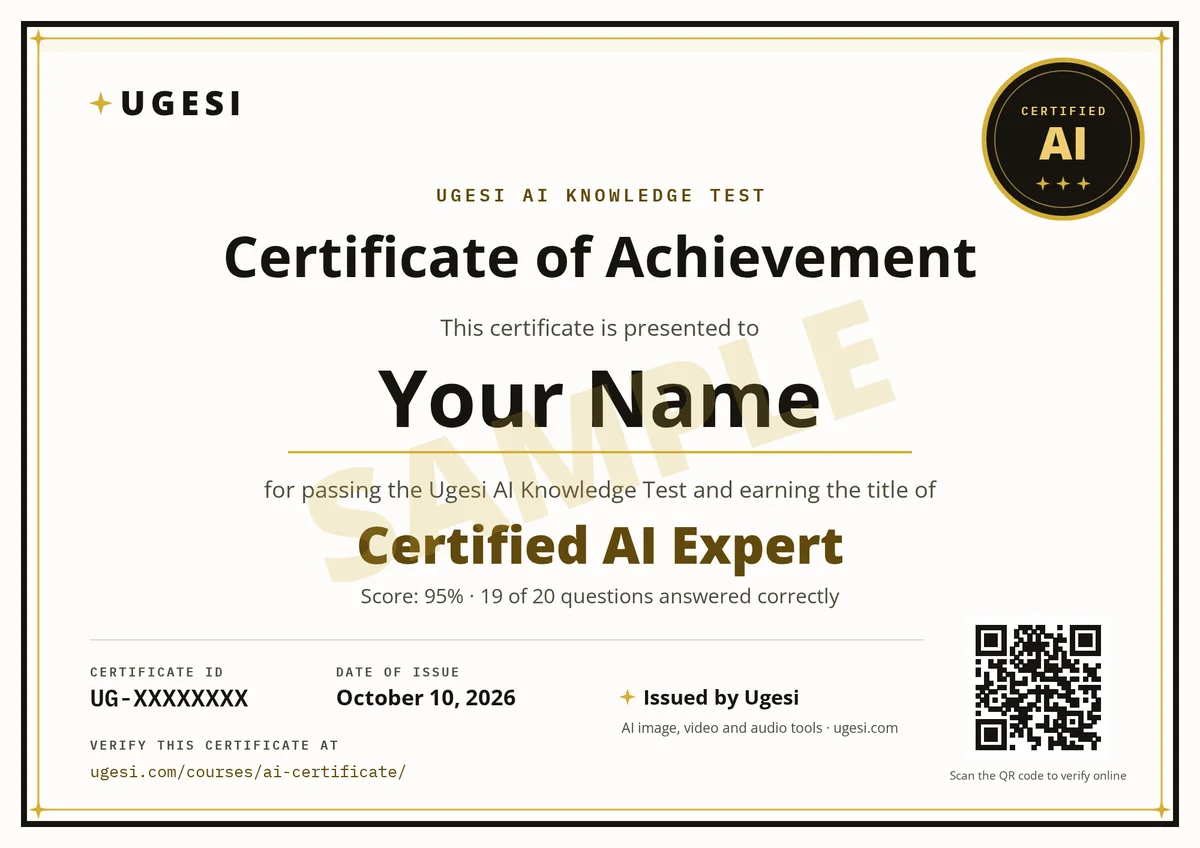
How to get a free AI certificate online
- Start the test: 20 questions drawn at random from a bank of 60, with 20 minutes on the clock.
- Answer at your own pace. You can go back and change any answer before you finish.
- See your score straight away, with a review and a short explanation for every question.
- With 70% or more, type the name for the certificate. Then download it as PNG or PDF, or add it to your LinkedIn profile.
Certificate levels
70 to 79%: Certified AI Specialist. 80 to 89%: Certified AI Professional. 90 to 100%: Certified AI Expert. The level and the score appear on the certificate and on its verification page.
Verifiable and easy to share
Every certificate has its own ID and a public verification page with the name, level, score and date. The QR code on the certificate leads there, so a recruiter or a client can check it in seconds.
Prepare with free AI courses
Our free AI courses on images, video, music and AI influencers cover most topics in the test. Every lesson has a practice task. Take them first, then come back for the certificate.
- Creating images with AI
- AI video production: from brief to export
- Creating music with AI
- AI influencer: zero to first post
What this certificate is, and what it is not
It is a free certificate of achievement from Ugesi: it shows that you passed our AI knowledge test. It is not a university degree or an accredited qualification, and it does not require any purchase. We may withdraw a certificate issued under an offensive name or obtained with automated tools.
AI certificate FAQ
Is the AI certificate really free?
Yes. The test and the certificate are free, with no account and no card. You download the certificate as PNG or PDF and share its verification link.
How many questions are in the AI certificate test?
20 multiple-choice questions drawn from a bank of 60, with 20 minutes to finish. You need 70% to pass.
Can I add the certificate to LinkedIn?
Yes. After you pass, use the Add to LinkedIn profile button. It opens LinkedIn with the certificate name, issuer, date, ID and verification link filled in.
How can someone verify my AI certificate?
Each certificate has a unique ID and a public verification page. The QR code on the certificate links to it. The page shows the name, level, score and date of issue.
What happens if I fail the test?
You see your score and a review of every answer with an explanation. Study the topics you missed and take a new test later; each test draws a new set of questions.
Is this an accredited AI certification?
No. It is a certificate of achievement for passing the Ugesi AI knowledge test. It shows practical knowledge of generative AI, not an academic or official qualification.
Which languages is the test available in?
English and Polish. The certificate is issued in the language of the test.
Do I need to take a course first?
No, but the free AI courses on images, video, music and AI influencers cover most of the topics. They help you pass on the first try.
Is this a generative AI certificate?
Yes. The test is about generative AI in practice. It covers writing prompts, creating images, video and audio, choosing models and using AI content responsibly. It does not test programming or machine learning theory.
